

Language and Emotion
what language do you feel in?

A couple of weeks ago, a friend asked me what language I felt more comfortable speaking during difficult conversations, and we were both surprised at my–reluctant, but honest–answer. Although Portuguese is my native language, the first one I learned to speak, hear, and express myself in, I feel a thousand times more comfortable having difficult conversations in my second language: English. I have since discussed this with a few of my bilingual friends, and I’ve gotten mixed responses.
As soon as I learned how to read my mom made it a rule at home we’d only watch movies in their original languages; I am very grateful for her efforts to help me learn a second language. But since moving to an international school at 13, and subsequently moving abroad, I have been speaking English as a primary language at school, work, and with every friend I’ve made since. These fundamental years of my life have completely shaped the way I see the world, and also the way I feel. But I have noticed that I feel differently depending on the language I’m speaking.

A lot of linguists, behavioral analysts, anthropologists, and other inter-disciplinary researchers have done extensive work on the phenomena of “code switching,” and how, often, bilingual speakers will alternate between languages in a conversation. It is a proven fact that bilingual speakers associate different languages with their emotions, frequently being able to express themselves better in their native language. But what I have experienced is quite the opposite, which initially made me feel guilty and disconnected from my roots, but after some thinking, I believe it helped me understand myself better.
I have seen many of my fellow multilingual friends talk about how their personality changes a bit, especially their mannerisms, when they change languages. If you speak multiple languages you are definitely aware of this. In Portuguese I speak with a strong carioca (carioca means a person from the city of Rio de Janeiro) accent, I start every sentence with slang, and my voice sounds much lower. In English, I speak more polished, more elegantly maybe, even though I still use a lot of slang and speak equally as fast. But still, most of my bilingual friends can agree that they prefer their native languages when getting in a heated argument or difficult conversation, concluding that their “truer” version, or “original” version is the one in their native language.
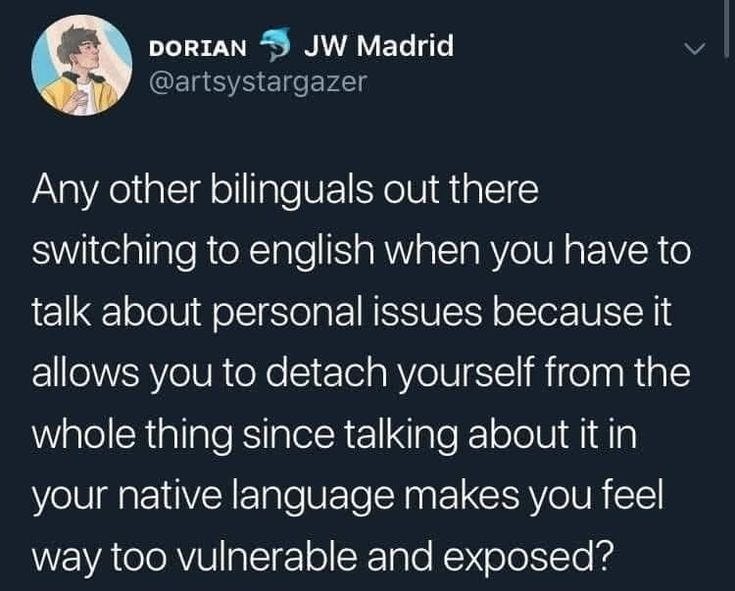
Although code switching has been used to describe the change in language, this idea of different versions of yourself based on the different languages you speak is what stuck with me. When code switching, you are not just changing the language you are speaking, but the relationship you have with those words. Words themselves carry not just meaning, but emotions and memories.
Up until I was 13, I had lived a very sheltered, conservative life. A lot of topics and conversations were very taboo, many heated and angry arguments as well as lectures were made in my direction, and I felt a heavy pressure from the environment I was in. I was a very quiet kid, didn’t have many friends in school, and spent most of my time reading and drawing. That is, until I moved schools and started to break out of my shell. My small international school exposed me to a different world in which I could develop and bloom. All in English.
The version of myself that started to exist then became my “truer” self and I was slowly able to develop my emotions, talk freely, without reprimands or taboo. I started to form connections and learned how to have difficult conversations. I started to actually form the vocabulary to express myself. All in English.
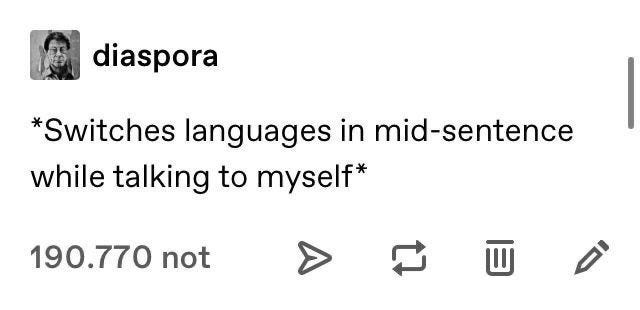
I asked a friend who was also raised in the same language dichotomy, and she has another perception of this. “When I speak with you, even though I know you both understand both languages, I always go straight to english. But when I talk to [friend] I go for Portuguese. I think it’s because I know her from a time when I spoke more Portuguese, but I know you from a time where I speak more English.” In her perspective the language she uses depends on the memories she carries of a person.
Yet another friend of mine is faithful to the linguist’s analysis, believing it is much easier to express herself in her native language. And there is a sharp difference between her story and mine. In school–where she spoke more Portuguese than English–she had many friends and relationships. She had learned to express herself and develop that vocabulary in her native language. Further corroborating my understanding that what determines what language you feel more comfortable using is the emotion and memory carried by the words in each language.
I started to go over my language choices when speaking with someone who understands both languages. My brother, for example, is fluent in the same languages as me. When I talk to him the only determining factors of what language to use are subject matters, or emotions. Recently I was venting to my brother and what I noticed was that the more emotional the topic was the more I completely switched the language to english. Certain words, like “overwhelmed” and “frustrated” felt more real and genuine in english, I felt like I couldn’t quite find these emotions in Portuguese. But before hanging up it only felt right to say: “Anyways, thanks for listening, te amo.”
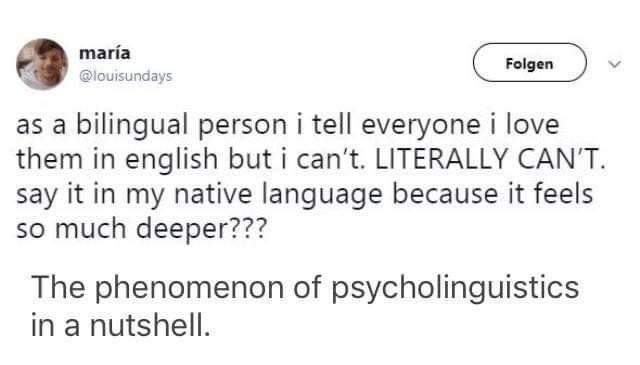
I definitely learned to love in my native language. My family, my friends, nature, God, all forms of love were not an issue. Saying I love you has always felt true, or even truer, in my native language, because I knew the emotion and the memory connected to the words te amo. But words that felt forbidden like depression, anxiety, sex, or even words that I had to say too much and their memories carry guilt or shame feel heavier and harsh on my tongue. It feels like if I tried to say them in Portuguese I’d immediately start crying. I’d be 13 again trying to be quiet, and trying to be someone I am not.

Although I think some of the linguists and scholars who affirm bilingual people express themselves better in their native language are often correct, it is important to remember that language carries emotion and memory. I read a study that puts it very well:
“Bilingual speakers often observe that their first (L1) and second languages (L2) are differentially associated with their emotional experiences, and that this can guide their choice of which language to use (Pavlenko, 2005). These observations have raised fundamental questions about the link between language and emotion, and more specifically, the use of code-switching (CS; i.e., alternation between two or more languages within a single conversation, Myers-Scotton, 1993) as a potential tool for managing one’s emotions.”
Being bilingual offers you a wider range of emotions, and more tools with witch to deal with them. Speaking of an issue in english might make you feel more distant from it and perhaps more able to articulate without getting emotional; for better or for worse. As much as it can work for our advantage, creating a new version of ourselves, it can also lead to suppressing unresolved issues. I guess it is both a blessing and a curse. As I write this post in English, I wonder what that says about me, and my relationship with self examination and criticism in my native language.
Citing my sources: